
 By kevin
Canada’s electricity sector stands at a defining crossroads. The Clean Electricity Regulations, finalized and now in force since December 2024, set a legally binding path for the country’s power grid to reach net-zero emissions by 2035. This means every coal and gas plant across the country will need to meet an annual emissions limit of just 65 tonnes of CO2 per gigawatt-hour starting in 2035, a threshold so stringent it effectively phases out unabated fossil fuel generation within the next decade.
For anyone tracking Canada’s climate commitments, the “2035 generation” represents more than a regulatory deadline. It embodies a fundamental restructuring of how Canadians produce and consume power, touching everything from provincial energy planning to Indigenous energy sovereignty, utility investments to household electricity bills. The regulations arrive as part of Powering Canada Strong, the federal strategy aiming to double the country’s electricity supply by 2050 while eliminating emissions from generation.
The stakes couldn’t be higher. Success means cleaner air, climate progress, and the foundation for electrifying transportation and heating. Failure risks stranded assets, legal challenges, and a climate trajectory incompatible with international commitments. The transition hinges on collaboration between federal and provincial governments, utilities, Indigenous nations whose lands host energy projects, and communities demanding both reliability and justice in how this transformation unfolds.
What Changed: Clean Electricity Regulations Now in Force
Canada’s Clean Electricity Regulations, finalized in December 2024 are now in force and represent the most significant legal framework for decarbonizing the country’s electricity sector. These regulations establish the binding rules that will govern how Canada generates power for the next quarter-century, creating enforceable standards where voluntary commitments once stood.
At the heart of the regulations lies a concrete emissions limit: power generators must stay below 65 tonnes of CO2 per GWh of electricity produced annually between 2035 and 2049. To understand what this means, a gigawatt-hour (GWh) is the energy needed to power roughly 90 Canadian homes for a year. The 65-tonne threshold is low enough to effectively phase out traditional coal and most natural gas generation without carbon capture technology, while allowing limited flexibility for grid stability during the transition.
This emissions limit doesn’t just set a target, it creates legal accountability. Facilities that exceed the standard face regulatory consequences, shifting renewable energy development from aspiration to compliance obligation. The regulations mandate that all electricity generation meets this threshold by 2035, establishing that year as a hard deadline rather than an optimistic goal.
The framework functions as the legal backbone of Canada’s broader commitment to reach net-zero emissions by 2050. Net-zero means balancing any remaining greenhouse gas emissions with an equivalent amount removed from the atmosphere, so the total impact is zero. Achieving net-zero economy-wide starts with cleaning up electricity first, since renewable power will fuel the electrification of transportation, heating, and industry.
By setting these standards now, the regulations provide the certainty developers and investors need to commit billions toward wind farms, solar installations, battery storage, and grid upgrades. Every renewable project approved between now and 2035 is part of this legally-mandated transformation, the ‘2035 generation’ of clean electricity infrastructure.
The regulations also establish monitoring and reporting requirements that enable legal oversight. Power generators must demonstrate compliance through verified emissions data, creating transparency that environmental law organizations can use to hold both government and industry accountable. This legal architecture ensures the 2035 deadline carries real consequences, transforming Canada’s climate commitments into enforceable obligations.
Key Developments Shaping Canada’s 2035 Renewable Energy Landscape
1. Powering Canada Strong: Doubling Electricity Supply by 2050
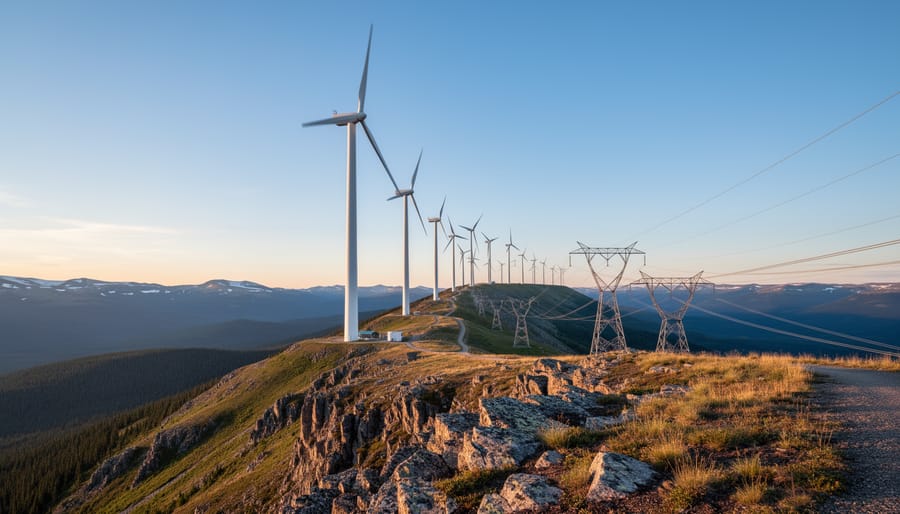
Canada’s path to a clean electricity future hinges on an ambitious infrastructure transformation. The Government of Canada’s national strategy, “Powering Canada Strong,” sets out to double electricity supply by 2050, a massive undertaking that positions 2035 as a critical checkpoint. This isn’t simply about adding capacity; it requires rebuilding the grid itself to handle expanded generation from wind, solar, hydro, and other renewable energy sources across diverse geographies.
The scale of this buildout demands thousands of kilometers of new transmission lines, upgraded interconnections between provinces, and storage infrastructure to balance intermittent generation. By 2035, much of this foundational work must be underway to stay on track for the 2050 target. That timeline compresses decades of typical infrastructure planning into just over a decade, creating intense pressure on regulatory systems.
Environmental law advocacy becomes crucial during this accelerated expansion. Every major transmission project triggers environmental assessment processes designed to evaluate impacts on ecosystems, waterways, and wildlife corridors. The permitting phase, where projects receive approval to proceed, offers a key intervention point for legal organizations to ensure robust habitat protection measures, meaningful Indigenous consultation, and enforceable mitigation commitments. When developers rush to meet 2035 milestones, the risk of cutting corners on environmental safeguards increases.
The legal frameworks governing these processes must evolve to handle the volume and pace of applications without sacrificing environmental rigor. This creates opportunities for environmental law charities to advocate for stronger assessment standards, transparent public participation mechanisms, and accountability measures that prevent the clean energy transition from inadvertently harming the ecosystems it aims to protect. The 2035 milestone isn’t just an energy target, it’s a test of whether Canada can scale renewable infrastructure responsibly.
2. Investment Tax Credits and Financial Incentives Through 2035
Canada’s investment tax credits for clean energy represent one of the most aggressive financial incentive programs in the country’s history. These refundable tax credits, available through 2035, offer developers substantial returns on qualifying renewable energy projects, solar installations, wind farms, energy storage systems, and grid infrastructure improvements all qualify under the program. The refundable structure means even projects without immediate tax liability can access these benefits, removing a traditional barrier that kept smaller developers and community-led initiatives on the sidelines.
The 2035 deadline creates urgency in the investment community. Developers are racing to secure financing, complete environmental assessments, and break ground before incentives phase down. This compressed timeline accelerates renewable capacity additions but also raises environmental compliance concerns. Projects rushed through approvals may cut corners on habitat assessments, water impact studies, or consultation processes with affected communities.
From a legal accountability perspective, these incentives create leverage points. Environmental law organizations can tie tax credit eligibility to demonstrated compliance with environmental standards beyond minimum regulatory requirements. This means advocating for conditions that protect migratory bird habitats near wind installations, ensure solar developments don’t fragment critical ecosystems, and require robust monitoring of water use in hydroelectric expansions.
The incentive structure also presents opportunities for Indigenous communities to participate as project partners rather than merely stakeholders consulted after decisions are made. Legal frameworks can ensure Indigenous-led renewable projects access these credits on equitable terms, with benefits flowing directly to communities whose territories host the infrastructure.
As 2035 approaches, the credits drive billions in private investment decisions happening right now in 2026. Legal organizations must monitor whether this capital rush serves both climate and environmental protection goals, or creates new problems requiring future remediation.
3. Flexibility Mechanisms: Compliance Credits and Staggered Implementation
The Clean Electricity Regulations don’t operate as a rigid on-off switch. Instead, they incorporate flexibility mechanisms designed to help provinces and utilities navigate the transition to net-zero electricity without compromising grid reliability or triggering economic disruptions. These provisions acknowledge that Canada’s electricity systems vary widely, from hydroelectric-dependent Quebec to coal-reliant Alberta, and that a one-size-fits-all timeline could destabilize both energy security and regional economies.
The regulations provide three primary flexibility tools:
- Compliance credits allow facilities that exceed emission reduction targets to bank credits for future use or trade them with facilities still working toward compliance, creating market incentives for early action.
- Offset credits enable generators to purchase verified emissions reductions from other sectors, providing an interim pathway for facilities undergoing technical retrofits or fuel switching.
- Staggered implementation timelines give different facility types varying deadlines based on their current configurations and regional grid roles, preventing premature closures that could destabilize electricity supply.
These mechanisms serve a legitimate purpose: preventing brownouts, managing transition costs, and giving utilities time to build replacement capacity. However, flexibility creates space for potential abuse. Compliance credits could become perpetual escape hatches if poorly monitored. Offset credits might fund questionable projects that don’t deliver genuine emissions reductions. Staggered timelines could extend fossil fuel generation far beyond what’s technically necessary.
This is where legal oversight becomes essential. Environmental law organizations monitor how provinces interpret these provisions, ensuring flexibility doesn’t morph into indefinite delay. Advocacy efforts focus on transparency, demanding public reporting of credit transactions, scrutinizing offset project validations, and challenging timelines that appear designed to protect incumbent fossil fuel assets rather than facilitate genuine transition. The goal isn’t eliminating flexibility but ensuring it advances the 2035 target rather than undermining it.
Why the 2035 Generation Matters: Environmental Justice and Legal Accountability
The 2035 deadline isn’t simply a regulatory milestone, it’s a test of whether Canada can build a clean energy future without sacrificing the ecosystems and communities that sustain us. As renewable energy infrastructure expands at unprecedented speed, legal frameworks must keep pace to ensure that solar farms, wind installations, and transmission corridors don’t fragment habitats, deplete water sources, or steamroll Indigenous rights in the name of climate progress.
Environmental law organizations play a crucial role in holding all parties accountable to their 2035 commitments. When a provincial utility fast-tracks a transmission line through wetlands, or when federal incentives inadvertently prioritize speed over environmental assessment rigour, legal advocacy ensures that shortcuts don’t become precedents. The regulations provide the framework, but enforcement and oversight determine whether they protect Canadian ecosystems or merely check bureaucratic boxes.
For Indigenous communities across Canada, the renewable energy transition presents both opportunity and risk. Wind projects on traditional territories can generate revenue-sharing agreements and training programs, creating economic benefits while respecting land stewardship practices. Yet without proper consultation and partnership, the same projects can disrupt sacred sites, hunting grounds, and waterways that have sustained communities for generations. Legal mechanisms like impact and benefit agreements, co-management arrangements, and enforcement of consultation requirements ensure that renewable energy planning respects Indigenous sovereignty rather than repeating the extractive patterns of fossil fuel development.
Communities in Northern Ontario have partnered with developers to site solar installations in ways that avoid critical wildlife corridors, demonstrating how early Indigenous involvement improves project outcomes. In contrast, rushed approvals elsewhere have led to legal challenges that delay projects and erode trust. The 2035 timeline makes these partnerships essential, not optional. Environmental law charities support these collaborations by providing legal expertise, ensuring agreements are enforceable, and challenging projects that fail to meet consultation standards or environmental safeguards. The next nine years will define whether Canada’s renewable energy boom becomes a model of environmental justice or another chapter of unintended harm.

What to Watch: Legal and Policy Developments on the Road to 2035
Between now and 2035, several critical areas demand attention from anyone committed to ensuring Canada’s renewable energy transition protects both ecosystems and communities. Provincial implementation will vary significantly, some provinces may adopt more stringent standards than federal regulations require, while others might seek exemptions or compliance flexibility. Monitoring how each province interprets and applies the Clean Electricity Regulations will reveal where legal advocacy can strengthen environmental protections.
Environmental assessment processes for major transmission lines, solar farms, and wind installations will set important precedents. Watch for cases involving habitat fragmentation, migratory bird corridors, and wetland impacts during infrastructure expansion. These assessments establish the legal standards future projects must meet, making early intervention crucial. Water use emerges as another priority: renewable energy facilities, particularly hydroelectric and some cooling systems, require careful oversight to prevent harm to aquatic ecosystems and downstream communities.
Indigenous rights and consultation present both challenges and opportunities. Legal frameworks must ensure meaningful consent processes, not just token consultation, as renewable projects move forward on traditional territories. Environmental law organizations are preparing to support Indigenous communities in asserting their rights and ensuring any development respects treaty obligations and environmental stewardship practices.
Regulatory amendments are inevitable as implementation reveals gaps or unintended consequences. The compliance credit system, offset protocols, and flexibility mechanisms will likely face adjustments. Advocacy efforts focus on preventing these modifications from weakening environmental protections while acknowledging the effects of fossil fuels we’re trying to phase out.
Stay informed through government regulatory updates, environmental law publications, and Indigenous-led organizations monitoring energy projects. Understanding how to engage with these processes equips you to participate in shaping implementation that truly serves environmental justice.
Frequently Asked Questions About Canada’s 2035 Renewable Energy Transition
Net-zero electricity by 2035 means Canada’s electricity sector will produce no more greenhouse gas emissions than it removes from the atmosphere, achieved through the Clean Electricity Regulations’ annual emissions limit of 65 tonnes of CO2 per gigawatt-hour for generation facilities. This doesn’t mean every power plant shuts down overnight, it means the grid as a whole transitions to renewable sources while existing infrastructure adapts or phases out within the regulatory framework finalized in December 2024.
Will the shift to renewable energy affect my electricity reliability or costs?
The Clean Electricity Regulations are designed to maintain reliable supply while transitioning to clean sources, with flexibility mechanisms like compliance credits and staggered timelines to manage grid stability. Investment tax credits available until 2035 aim to offset transition costs, though regional variations in implementation may affect pricing differently across provinces.
What happens to existing fossil fuel power plants?
Fossil fuel generation facilities must meet the 65 tonnes per gigawatt-hour emissions limit between 2035 and 2049, meaning they’ll need to retrofit with carbon capture technology, transition to cleaner fuels, or phase out. The regulations provide flexibility for compliance through offset credits during this transition period.
How can I participate in or advocate for proper implementation?
Canadians can engage through provincial regulatory consultations, support environmental law organizations monitoring compliance, and participate in community input processes for renewable energy projects in their regions. Staying informed about environmental assessments and permitting decisions gives citizens meaningful opportunities to ensure projects meet environmental standards.
What role do Indigenous communities play in this transition?
Indigenous communities are essential partners in renewable energy planning, with legal rights to consultation on projects affecting their traditional territories and opportunities to lead or co-develop clean energy initiatives. Environmental law frameworks increasingly recognize Indigenous jurisdiction and knowledge systems as central to sustainable energy development.
What if provinces don’t meet the 2035 targets?
The Clean Electricity Regulations create federal legal accountability mechanisms that apply across Canada, establishing enforceable emissions limits regardless of provincial preferences. Environmental law organizations monitor compliance and can pursue legal remedies if governments or utilities fail to meet their obligations.
The transition to net-zero electricity represents both technical infrastructure changes and fundamental shifts in governance, requiring ongoing citizen engagement and legal oversight to ensure environmental protections aren’t compromised in the rush to build new capacity. Understanding these basics empowers Canadians to ask informed questions, participate meaningfully in local energy decisions, and support the legal advocacy work that holds all parties accountable to their 2035 commitments.
The 2035 generation represents far more than a regulatory deadline. It’s a defining moment for Canada’s environmental future, where legal frameworks, Indigenous leadership, and collective action converge to reshape how we power our communities. With the Clean Electricity Regulations now in force and national strategies mobilizing investment, we’ve entered the decisive decade of transformation.
Success depends on maintaining accountability every step of the way. Environmental law organizations serve as guardians of this transition, ensuring renewable energy expansion doesn’t sacrifice ecosystems, water resources, or Indigenous rights in the race to meet targets. Legal advocacy creates the safeguards that turn ambitious goals into responsible reality.
Indigenous communities aren’t just stakeholders in this transition, they’re essential partners whose knowledge and rights must shape every project and policy decision through 2035 and beyond. Their leadership ensures renewable energy development respects traditional territories and builds genuine reconciliation into Canada’s energy future.
You have a role here. Stay informed about how regulations are implemented in your region. Support environmental law efforts that demand transparency and enforce protections. Speak up when developments threaten local ecosystems. The 2035 generation succeeds only when citizens, legal advocates, and communities work together to hold all parties accountable to their commitments, building the clean energy future Canada needs while safeguarding the land and waters we all depend on.