
 By kevin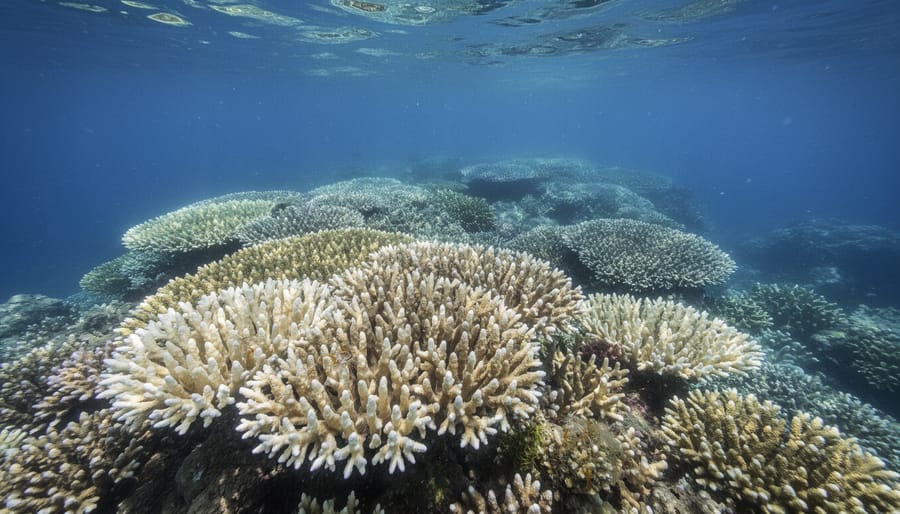
Climate change irreversibility refers to the point at which certain planetary changes become permanent on human timescales, unable to be reversed even if greenhouse gas emissions stop entirely. At our current trajectory of approximately 1.4°C above pre-industrial temperatures, we’ve already crossed some critical thresholds. Warm water coral reefs are experiencing unprecedented dieback as they pass their thermal tipping point right now. Sea level rise, once set in motion, will continue for hundreds to thousands of years regardless of future action.
But irreversibility isn’t a single cliff edge. It’s a cascade of tipping points, each with different thresholds and timescales. The question isn’t simply “when” climate change becomes irreversible, but rather which systems we can still protect and which changes we must now adapt to. Recent assessments show that up to eight major tipping points could be triggered below 2°C of warming, with some already within reach at current temperatures.
Here’s what makes this moment critical: global warming must peak below 2°C and then return under 1.5°C as quickly as possible to limit further tipping points. Long-term stability requires cooling to around 1°C above pre-industrial levels. These aren’t abstract targets. They represent the difference between manageable disruption and catastrophic, permanent transformation of Earth’s life-support systems.
For those of us working on climate change in Canada understanding these thresholds matters because they inform the legal, policy, and community responses we need today. Indigenous communities have witnessed these changes firsthand, their traditional knowledge documenting shifts in ecosystems that science is only now quantifying. This article breaks down what irreversibility means in practical terms, which changes can still be prevented, and what legal pathways exist to protect what remains at stake. The science is clear, but the future isn’t written yet.
What Climate Irreversibility Means
Climate irreversibility refers to changes in Earth’s systems that cannot be undone on timescales meaningful to human civilization, typically spanning centuries to millennia. The term doesn’t describe a single moment when everything becomes permanent; rather, it captures a spectrum of impacts with vastly different recovery timeframes.
Understanding irreversibility requires distinguishing between several related but distinct concepts:
- Irreversible change
- A shift in a climate system or ecosystem that persists for hundreds to thousands of years even if greenhouse gas emissions stop completely. Sea level rise from ice sheet loss exemplifies this category.
- Tipping point
- A critical threshold where a climate system shifts abruptly from one stable state to another, often triggering self-reinforcing feedback loops that make reversal extremely difficult or impossible on human timescales.
- Committed warming
- Additional temperature increase already locked in by past and current emissions, which will occur even if all emissions stopped today due to the time lag in how Earth’s climate responds to greenhouse gases.
- Thermal inertia
- The resistance of climate systems, particularly the oceans, to rapid temperature change, causing warming to continue for decades after emissions peak.
- Climate lag
- The delay between when greenhouse gases enter the atmosphere and when their full warming effect manifests, meaning today’s emissions commit us to future temperature increases.
Some changes already set in motion, such as continued sea level rise, are irreversible over hundreds to thousands of years. Even if humanity achieved net-zero emissions tomorrow, thermal inertia in the oceans means global temperatures would decline only slowly, and ice sheets would continue losing mass for centuries. These processes operate on geological timescales that dwarf the span of human history.
Yet not all climate impacts fall into this category. Many ecosystems can recover if warming stabilizes and doesn’t exceed their adaptive capacity. Air quality improves within years when pollution drops. Some regional rainfall patterns can shift back if temperature increases reverse. The crucial distinction lies in whether a system has crossed its tipping point, the threshold beyond which it enters a fundamentally different, often self-perpetuating state.
How Climate Tipping Points Work
Climate tipping points operate like a ball perched on the crest of a hill. When the system is stable, you can nudge it slightly and it rolls back to its original position. But push it past a critical threshold, and it rolls down the other side into an entirely different state. Unlike gradual climate change, where warming or impacts increase steadily as greenhouse gas emissions rise, tipping points represent threshold moments where a climate system fundamentally reorganizes itself.
Once crossed, these transitions become self-reinforcing and extremely difficult to reverse. The Arctic ice sheet illustrates this mechanism clearly: white ice reflects sunlight back to space, keeping the region cool. As warming melts the ice, darker ocean water is exposed, absorbing more heat and accelerating further melting. This feedback loop means that even if we stopped all emissions, the system would continue changing for decades or centuries before finding a new equilibrium.
What makes tipping points particularly dangerous is their capacity for cascading effects. One tipping element can destabilize others. Thawing permafrost releases methane and carbon dioxide, which accelerates warming, which can then push other systems (tropical rainforests, ocean circulation patterns) toward their own thresholds. These interconnected risks create the potential for domino effects across Earth’s climate system.
Scientists identify tipping points by looking for nonlinear changes in Earth system behavior, where small additional forcing produces disproportionately large responses. The collapse of ice sheets, the die-off of coral reef ecosystems, or the shutdown of major ocean currents all represent such threshold behaviors. Importantly, many tipping points exist on timescales far longer than human lifespans. A tipping point crossed today might unfold over hundreds or thousands of years, but the transition becomes locked in relatively quickly.
Current evidence shows we are already in dangerous territory. At approximately 1.4°C of global warming, warm water coral reefs are crossing their thermal tipping point and experiencing unprecedented dieback. Up to eight tipping points could be reached below 2°C of warming, and recent assessments suggest several exist in the 1°C to 2°C range where we now find ourselves. This is why the distinction between gradual change and tipping points matters enormously for climate policy and environmental law.
Critical Temperature Thresholds and What Happens at Each
Where We Are Now: 1.4°C and Counting
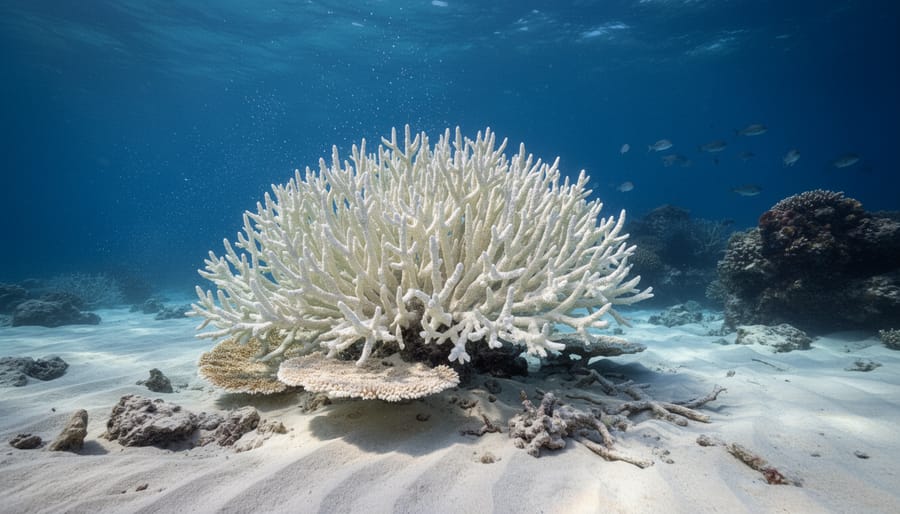
The planet has already warmed by approximately 1.4°C above pre-industrial levels, and we’re witnessing the first climate systems crossing their tipping points in real time. Warm water coral reefs stand as the most visible casualty of current temperatures, with scientists documenting unprecedented dieback of reefs as ocean temperatures push these ecosystems beyond their thermal tolerance. These vibrant marine habitats, which support a quarter of all ocean species despite covering less than one percent of the ocean floor, are bleaching and dying at rates never before recorded.
This isn’t a future threat, it’s happening now. Current warming levels place us within the lower uncertainty ranges of several other tipping points identified by climate researchers. The 1.4°C we’ve reached represents more than a number; it marks the threshold where theoretical climate models meet observable ecological collapse. Coral reefs won’t recover on human timescales once their tipping point is crossed, making them a stark warning of what irreversibility looks like in practice.
The 1.5°C to 2°C Danger Zone
The science is clear: to limit tipping point risk global warming must peak below 2°C and then return under 1.5°C as quickly as possible. This isn’t just a policy target, it’s a threshold zone where Earth systems begin to destabilize in ways we can’t easily reverse.
Recent IPCC assessments identify many tipping points in the 1°C to 2°C range, meaning we’re already entering dangerous territory. Our current warming of approximately 1.4°C places us within the lower uncertainty ranges for several critical tipping points. Scientists warn that up to eight tipping points could be triggered below 2°C warming, including collapse of ice sheets, shutdown of ocean circulation systems, and dieback of tropical forests.
What makes this range especially treacherous is how these tipping points can cascade. One system’s collapse can accelerate others, creating feedback loops that amplify warming beyond our emissions alone. The difference between 1.5°C and 2°C might seem small, but it represents the margin between maintaining some stability in Earth systems and triggering multiple irreversible shifts simultaneously.
This is why Canadian environmental law must enforce aggressive emission reductions now, not decades from now. Every tenth of a degree matters. We’re not aiming for a nice-to-have target, we’re fighting to stay below thresholds that separate manageable climate change from runaway destabilization.
Long-Term Stabilization Goals
Even if we limit warming to below 2°C in the near term, the work doesn’t end there. Climate scientists recommend that global temperatures must cool to around 1°C above pre-industrial levels in the long term to minimize the risk of crossing irreversible tipping points and to allow critical Earth systems time to stabilize.
This long-term target reflects a crucial insight: returning to lower temperature levels after a temporary overshoot offers the best chance to restore some climate stability and prevent cascading tipping points from triggering each other. Getting there requires not just halting emissions but achieving net-negative emissions through natural climate solutions like forest and wetland restoration, alongside emerging carbon removal technologies.
The timeline for reaching this 1°C stabilization goal extends decades beyond the mid-century net-zero targets most countries have set. It demands sustained political will, ongoing legal enforcement of climate commitments, and economic transformation that prioritizes long-term planetary health over short-term extraction. For Canada, this means protecting carbon-rich ecosystems like boreal forests and peatlands while supporting Indigenous land stewardship that has maintained these systems for millennia.
Types of Irreversible Climate Changes
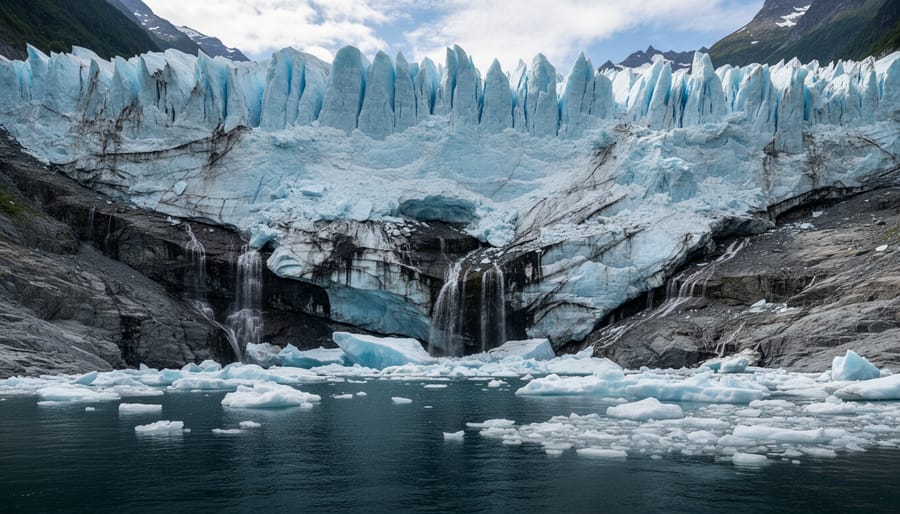
Climate scientists categorize irreversible changes based on the physical mechanisms that make them self-reinforcing and the timescales over which they persist. Understanding these categories helps clarify which impacts humanity can still prevent and which require adaptation strategies spanning centuries.
Ecosystem Collapse and Biodiversity Loss
Warm water coral reefs represent the clearest example of ecosystem tipping points already being crossed. At current warming of approximately 1.4°C, these vital marine ecosystems are experiencing unprecedented dieback as ocean temperatures push past their thermal tolerance limits. Once coral bleaching events become severe enough, entire reef systems collapse, eliminating habitat for countless species. The loss happens faster than natural recovery can occur, making it functionally irreversible on human timescales even if temperatures later stabilize.
Tropical rainforests, particularly the Amazon, face similar collapse mechanisms. As warming and deforestation combine to reduce rainfall, forests dry out and become vulnerable to cascading fires. Beyond a critical threshold, rainforest ecosystems flip to savanna states that cannot support the original biodiversity or carbon storage capacity.
Ice Sheet Disintegration
The Greenland and West Antarctic ice sheets contain enough frozen water to raise global sea levels by several meters each. These massive ice formations respond slowly to warming, but once they begin substantial melting, the process becomes self-reinforcing through multiple feedback mechanisms. As ice surfaces lower into warmer air, melting accelerates. Meltwater lubricates the base of glaciers, speeding their slide toward the ocean. Dark meltwater pools absorb more sunlight than white ice, further increasing temperatures.
Critically, ice sheet collapse unfolds over centuries to millennia once triggered, meaning the commitment to meters of sea level rise can be locked in decades before the water actually floods coastlines. Current science suggests portions of these ice sheets may already be past their tipping points at today’s temperatures.
Ocean Circulation Disruption
The Atlantic Meridional Overturning Circulation (AMOC), which includes the Gulf Stream, redistributes heat throughout the North Atlantic and influences weather patterns across multiple continents. Freshwater from melting Greenland ice dilutes the salty North Atlantic water that normally sinks and drives this circulation. Sufficient freshwater input can weaken or collapse the AMOC entirely, a shift that would persist for centuries and dramatically alter regional climates, particularly cooling parts of Europe while disrupting monsoon patterns in Africa and South America.
Permafrost Thaw and Carbon Release
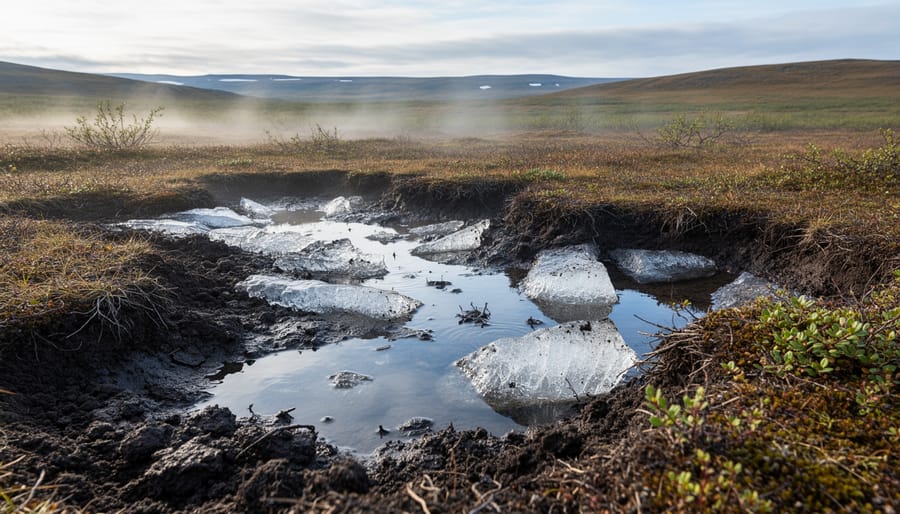
Arctic permafrost stores massive quantities of organic carbon that has remained frozen for thousands of years. As permafrost thaws, microbes decompose this organic matter, releasing carbon dioxide and methane into the atmosphere. This creates a reinforcing feedback loop where emissions from thawing permafrost drive additional warming, which thaws more permafrost. Once initiated at scale, this process continues independently of human emission reductions, adding warming that persists until the permafrost carbon reserves are exhausted.
Sea Level Rise
Perhaps the most certain irreversible impact is continued sea level rise. Even if all emissions stopped immediately, thermal expansion of warming oceans and ongoing ice melt would continue raising sea levels for hundreds to thousands of years. The ocean’s massive heat capacity means it takes centuries to reach equilibrium with atmospheric temperatures, while ice sheets respond even more slowly. Research confirms that changes already set in motion guarantee substantial additional sea level rise regardless of future emission pathways, though the ultimate magnitude depends critically on how much additional warming occurs.
Major categories of irreversible or long-lasting climate changes include:
- Coral reef die-off from ocean warming exceeding thermal tolerance limits
- Ice sheet collapse in Greenland and Antarctica driven by self-reinforcing melting feedbacks
- AMOC shutdown caused by freshwater dilution from melting ice disrupting ocean circulation
- Amazon rainforest dieback where forests flip to savanna states under combined warming and deforestation stress
- Permafrost carbon release creating feedback loops as thawing releases greenhouse gases that drive further warming
- Sea level rise from thermal expansion and ice melt continuing for centuries even after emissions cease
Each of these changes operates on different timescales and crosses tipping points at different temperature thresholds, but all share the characteristic that they become difficult or impossible to reverse once substantially underway. The IPCC’s recent assessments place many of these tipping points in the range between 1°C and 2°C of warming, with current temperatures of about 1.4°C already within the lower uncertainty ranges for several critical thresholds.
What’s Already Locked In and What We Can Still Prevent
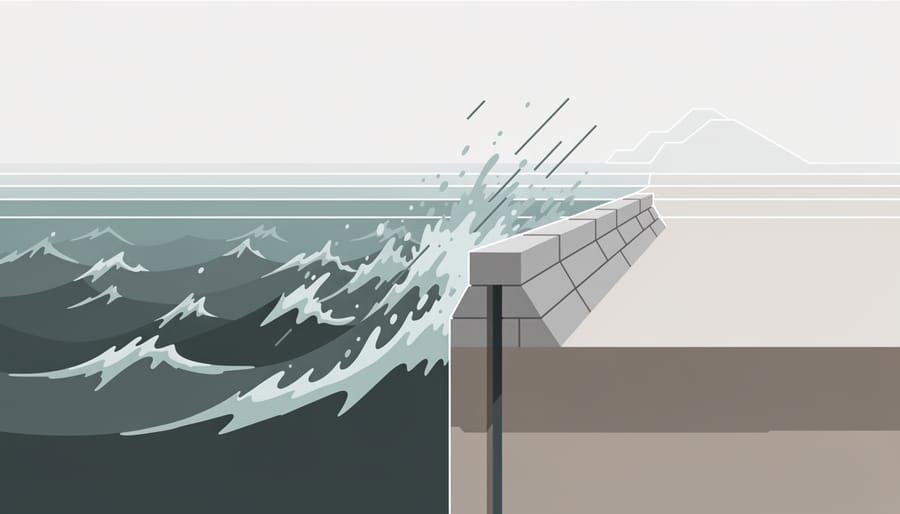
The scientific evidence shows a stark reality: some climate changes are already irreversible on human timescales, while others remain within our power to prevent. Understanding which is which helps focus our legal and policy efforts where they’ll have the greatest impact.
Sea level rise represents the clearest example of locked-in change. Even if we stopped all greenhouse gas emissions tomorrow, thermal expansion of ocean water and melting ice will continue for centuries. The process has tremendous momentum, warmer water physically occupies more volume, and massive ice sheets respond slowly to temperature changes. Scientists project continued sea level rise over hundreds to thousands of years based on warming already in the system. Coastal communities, particularly Indigenous nations along Canada’s extensive coastlines, will face adaptation challenges regardless of future emission pathways.
Some ecosystem losses also cross into irreversibility at current temperatures. Warm water coral reefs are experiencing unprecedented dieback at 1.4°C of warming, crossing their thermal tipping point now. Once these complex ecosystems collapse, rebuilding them takes thousands of years under ideal conditions, timescales that render the loss effectively permanent for countless human generations.
Yet much remains preventable. The difference between 1.5°C and 2°C of peak warming determines whether we trigger eight tipping points or substantially fewer. Arctic summer sea ice, the West Antarctic Ice Sheet, and Amazon rainforest dieback all sit near critical thresholds where rapid emission cuts could prevent their collapse. Permafrost thaw, which releases massive carbon stores and accelerates warming, can be limited if we act quickly. The Greenland Ice Sheet, while already losing mass, won’t reach full irreversible melt if we bring temperatures back below certain thresholds within decades rather than centuries.
The legal and policy actions we take in the next few years directly determine which systems we save. Courts can mandate emission reductions that keep additional tipping points out of reach. Indigenous-led conservation protects ecosystems buffering against threshold crossings. Environmental law holds polluters accountable for the damages their emissions cause, creating economic pressure for change.
This isn’t about preventing all climate impacts, that ship has sailed. It’s about preventing the worst, most catastrophic changes while we still can. The urgency is real, but so is our agency.
How Legal Action and Policy Can Address Climate Tipping Points
The scientific urgency around climate tipping points demands an equally urgent legal and policy response. Environmental law offers powerful tools to prevent ecosystems from crossing irreversible thresholds, and Canadian jurisprudence increasingly recognizes that the fossil fuels impact on Earth’s systems requires enforceable limits, not voluntary targets.
Courts can mandate emission reductions that keep warming below critical tipping points. Strategic litigation forces governments and corporations to align their actions with climate science, establishing legal precedents that recognize the difference between manageable climate impacts and catastrophic, irreversible changes. When policymakers delay, judicial review and constitutional challenges can compel the emission pathways needed to avoid triggering multiple tipping points below 2°C of warming.
Environmental law also provides mechanisms to hold polluters accountable for damages to ecosystems approaching tipping points. Liability frameworks can require restoration funding for degraded systems that still have a chance of recovery, while insurance and financial regulations can internalize the costs of irreversible climate damage into corporate decision-making before thresholds are crossed.
Protecting ecosystems at high risk requires targeted legislative action. Canada’s Species at Risk Act can safeguard biodiversity in regions where warming threatens ecological collapse, while land use laws can prevent development that pushes vulnerable areas past their resilience limits. Marine protected areas, when properly enforced, can create refuges for coral reefs and other ecosystems already experiencing unprecedented stress at 1.4°C of warming.
Nature’s Resilience Canada uses these legal tools to prevent irreversible damage across Canadian ecosystems. Our work focuses on enforcing existing environmental protections, challenging inadequate climate policies, and advancing nature-based solutions that both sequester carbon and restore ecosystem resilience. We collaborate closely with Indigenous communities whose traditional territories face irreversible changes, recognizing that Indigenous knowledge-keepers hold centuries of understanding about ecosystem thresholds and recovery.
These partnerships are essential. Indigenous Peoples manage lands that contain critical carbon stores and biodiversity hotspots, and their governance systems often embed long-term thinking that Western legal frameworks struggle to achieve. When Indigenous-led conservation receives legal backing and adequate resources, it protects ecosystems from crossing tipping points while honoring rights and sovereignty.
Policy must match the timescale of irreversibility. Laws that plan only for the next election cycle cannot address changes locked in for centuries. Canada needs climate legislation with enforceable long-term targets, regular scientific review, and built-in mechanisms to accelerate action as tipping point risks become clearer.
Frequently Asked Questions
Climate tipping points can feel abstract until you understand what they mean for the planet’s future. Here are answers to the most common questions people ask when trying to grasp the urgency of the irreversibility timeline.
What is a climate tipping point?
A climate tipping point is a critical threshold where an Earth system shifts from one stable state to another, often triggering self-reinforcing changes that continue even if emissions stop. Once crossed, these transitions are largely irreversible on human timescales.
How close are we to climate tipping points?
At current warming of approximately 1.4°C above pre-industrial levels, Earth is already within the range where some tipping points can be triggered. Recent assessments indicate that tipping points could be reached between 1°C and 2°C of warming, and up to eight tipping points could be crossed below 2°C.
When will climate change be irreversible?
Irreversibility is not a single moment but a spectrum. Some changes, like warm water coral reef dieback at 1.4°C, are already crossing thresholds, while continued sea level rise is locked in for hundreds to thousands of years. However, many impacts remain preventable if warming peaks below 2°C and returns under 1.5°C as quickly as possible.
Can climate tipping points be avoided?
Yes, many tipping points can still be avoided with urgent action to reduce emissions and limit warming. Experts recommend keeping peak warming below 2°C and cooling to around 1°C above pre-industrial levels in the long term to minimize the risk of triggering irreversible Earth system changes.
These questions reflect the core concerns that bring people to climate science in the first place. Understanding that we are already operating within tipping point ranges makes clear why legal and policy interventions cannot wait for perfect certainty. The science shows we have agency to prevent many catastrophic shifts, but that agency diminishes with every tenth of a degree of additional warming and every year of delayed action.
Climate irreversibility isn’t a single cliff edge we fall from, but a spectrum of changes unfolding across different timescales. Some shifts, particularly continued sea level rise, are already locked in for hundreds to thousands of years, no matter what we do today. Others remain preventable if we act with urgency. At 1.4°C of warming, we’re watching warm water coral reefs cross their thermal tipping point in real time. We know that up to eight critical tipping points could be triggered below 2°C, placing us squarely in the danger zone.
This isn’t cause for paralysis. It’s a call to mobilize every tool we have, especially the law. Environmental litigation can force emission reductions, hold polluters accountable, protect ecosystems teetering near irreversible collapse, and mandate the adaptation measures our communities need. Nature’s Resilience Canada works to deploy these legal mechanisms precisely when science tells us they matter most.
The path forward requires collaboration. Indigenous knowledge-keepers have protected ecosystems for millennia and understand the early warning signs of environmental breakdown in their traditional territories. Environmental groups bring organizing power and public voice. Legal advocates provide the enforcement muscle. Together, we create the united front needed to limit irreversible damage.
You have agency in this fight. Support organizations using environmental law to defend climate stability. Advocate for policies aligned with keeping warming below critical thresholds. Recognize that while some changes are permanent on human timescales, the difference between 1.5°C and 2°C, or between 2°C and 3°C, determines how many tipping points we trigger and how severe the irreversible consequences become. Every fraction of a degree we prevent matters. Every ecosystem we protect counts.