
 By kevin
For most research use, 98 percent is the sensible default, 95 percent works when the stakes are low, and 99 percent earns its place only when a batch-specific certificate of analysis proves it. Readers weighing options on Kylo Peptides’ Canadian site or anywhere else should ask the same question, because a purity figure with no documented evidence behind it is only a marketing line. Those three numbers sit close together on a label, but the claim behind each one matters far more than the gap between them. Our testing approach starts there: we judge the paperwork before we judge the percentage. Think of it the way conservation groups treat nature-based solutions: a promise means little until it can be checked against the record.
A certificate of analysis is a batch-specific lab report covering identity, purity, and traceability, and it only counts if its batch number matches the vial in your hand. Purity is also separate from quantity. A sample can pass one and fail the other. Below, we compare what each level means, where the differences actually show up, and which one fits your purpose.
95% vs. 98% vs. 99% Peptide Purity at a Glance
A peptide purity percentage describes how much of a tested sample is the intended peptide and how much is something else, usually leftover by-products from synthesis. We find the quickest way to read the three common tiers is side by side, so here is the short version before the detail.
| Purity tier | What remains in the sample | What the tier generally signals | Key consideration |
|---|---|---|---|
| 95% | About 95 parts target peptide, about 5 parts other material | A baseline level of purity that many people treat as acceptable for general use | The largest non-target fraction of the three, so it may be limiting for sensitive work |
| 98% | About 98 parts target peptide, about 2 parts other material | A middle tier with a noticeably smaller impurity share | Often a reasonable balance when you want tighter quality without chasing the top number |
| 99% | About 99 parts target peptide, about 1 part other material | The tightest of the three, with the least non-target material | Most worth prioritising for sensitive applications, though not automatically right for every use |
Notice how small the gaps look on paper. Going from 95 to 98 percent cuts the non-target share by more than half, while going from 98 to 99 halves it again. That is why a single percentage point can matter more than it appears.
Still, the percentage is only one claim among several. Purity, identity and quantity are three separate claims on a legitimate certificate of analysis, and a sample can pass on purity yet fail on quantity. A 99 percent figure with no batch-matched certificate behind it tells you less than a documented 98.
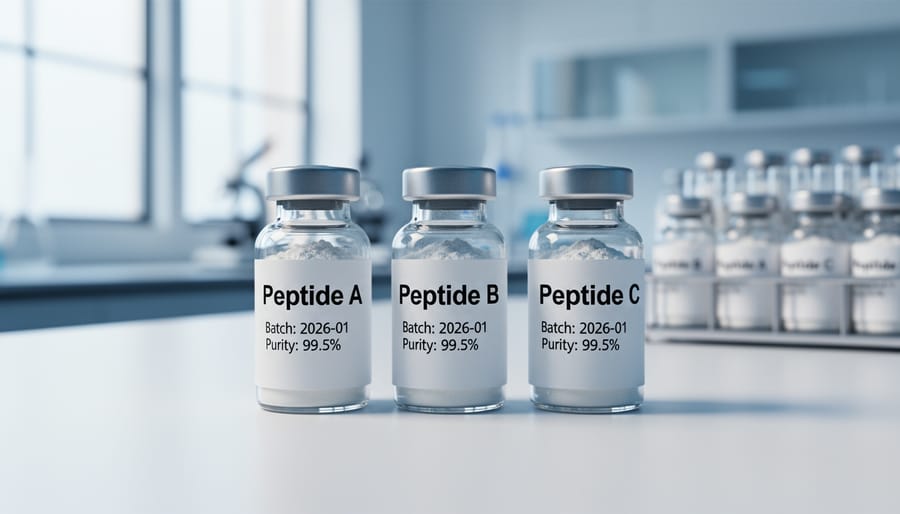
What Each Purity Level Is: Defining 95, 98 and 99 Percent
What ‘Percent Purity’ Actually Measures
Percent purity is simply the share of a sample that is the intended peptide, as opposed to leftover by-products from synthesis. A 98 percent result means roughly 98 parts in 100 are the target sequence. The remainder is something else, and understanding that split of purity vs impurities is the starting point for reading any certificate.
- Purity
- The proportion of a sample that is the intended peptide sequence.
- Impurity
- Anything else in the sample, such as truncated or incomplete chains left over from synthesis.
- HPLC
- A laboratory technique that separates a sample’s components and shows each as a peak on a chart.
- Batch/lot
- A single production run of material; a certificate applies only to the batch it names.
With HPLC, purity is usually read as area: the target peptide’s peak area divided by the total area of all peaks. That makes it a statement about composition. It does not tell you the amount in the vial, and it says nothing about safety or effectiveness.
95 Percent Purity
A 95 percent result means that up to five percent of the sample is something other than the target peptide, typically related impurities such as truncated or incomplete chains left over from synthesis. That is a larger leftover fraction than the other two tiers carry.
In our evaluation, this tier reads as acceptable for general, non-sensitive work where a small share of by-products won’t distort the outcome. It becomes limiting when precision matters, since impurities can confound results.
Either way, the figure alone proves little. Check that the certificate’s batch number matches your vial, and remember purity and quantity are separate claims.
98 Percent Purity
In practice, 98 percent purity means that roughly two parts in a hundred of the sample are something other than the target peptide. Those leftovers are usually related impurities from synthesis, such as truncated or incomplete chains. Because that fraction is smaller than at 95 percent but not as tightly controlled as at 99 percent and above, 98 percent is commonly treated as a middle tier.
In our testing of how these claims are documented, we found the figure only carries weight when a batch-specific certificate of analysis backs it. A matching batch number on the vial is what ties the 98 percent result to the product in hand.
99 Percent Purity
A 99 percent result, or higher, means roughly one part in a hundred of the sample is something other than the target peptide. In our experience, that is the tier people reach for when the work is sensitive and every impurity counts. But the headline number is not automatically the right call for every use. If the application tolerates a few extra percent of related impurities, the highest tier may add little. And 99 percent says nothing on its own about quantity: a sample can pass on purity and still fail on fill. Check that the certificate’s batch number matches your vial.
95 vs. 98 vs. 99 Percent, Dimension by Dimension
Purity Percentage: How Much Do a Few Points Matter?
On paper, the gap between 95, 98 and 99 percent looks tiny. In practice, each step shrinks the unwanted fraction. A 95 percent sample is roughly one part in twenty something other than the target peptide. At 98 percent that falls to about two parts in a hundred, and at 99 percent to about one.
The jump from 95 to 98 is a bigger relative improvement than the jump from 98 to 99, though the extra point still halves the remaining impurity fraction. For exploratory or less sensitive work, that may not change much. For sensitive applications, where a stray truncated chain could muddy a result, it can matter more.
So the right tier depends on the job. Treat the number as a description of composition, not a promise of quality. A 99 percent figure with no batch-matched certificate behind it tells you less than a documented 98 percent result you can actually verify.
Testing Methods: How Purity Is Measured
A legitimate certificate of analysis makes three separate claims, and each one needs its own evidence. A strong result on one does not cover the other two. This kind of testing and verification is what separates a documented claim from a marketing line.
- Purity: the share of the sample that is the target peptide, typically supported by HPLC.
- Identity: whether the peptide is the right molecule, typically supported by mass spectrometry.
- Quantity: how much peptide is actually in the vial, which needs its own separate result.
HPLC (high-performance liquid chromatography) separates a sample into its components and shows each as a peak. The size of the main peak relative to the rest is what produces a purity percentage like 95, 98 or 99. Mass spectrometry works differently. It measures the molecular weight of what is in the sample, so it can confirm the peptide is the intended one rather than a look-alike.
Because these are independent claims, a sample can pass on purity and still fail on quantity, or be correctly filled and carry a significant impurity. Read the certificate for all three results, not only the headline percentage.
Certificates of Analysis and Batch Specificity
A certificate of analysis, or COA, is a document from an analytical laboratory that records what was tested, how it was tested, and what the results were. For a research peptide, it should answer three separate questions: identity, purity, and batch traceability. Those are distinct claims, and a headline percentage only speaks to one of them.
Here’s the catch. A COA only proves something about the specific batch it names. If the batch number on the document doesn’t match the number printed on the vial in your hands, the certificate tells you nothing about that product. The same goes for a generic, batch-less COA: it might look official, but it can’t be tied to anything you actually hold. This is why we treat batch-specific claims as the only kind worth weighing. A 99 percent figure with no traceable batch behind it is an assertion, not evidence.
When you read a COA, check the batch number first, then see which tests were run and whether purity, identity and quantity are reported separately.
Purity vs. Quantity: Why a High Number Can Still Mislead
A high purity number can look reassuring, but it answers only one question. Purity tells you what share of the sample is the intended peptide. It says nothing about how much peptide is actually in the vial.
That distinction matters because purity, identity and quantity are three separate claims on a legitimate certificate of analysis. Each one is tested and reported on its own. A sample can pass on purity and still fail on quantity. The reverse can happen too: a vial can be filled correctly and still carry a significant impurity.
Think of it this way. A vial labelled 99 percent pure might contain far less peptide than its label states, and the percentage would still look perfect, because it only describes the composition of whatever is there. Likewise, a correctly filled vial might hold the expected amount while a sizeable fraction of it is something other than the target sequence.
In our hands-on reading of these documents, the headline figure was never enough on its own. Look for separate results for purity and quantity, and confirm the batch number matches the one printed on your vial. A certificate only proves something about the batch it names.
Weighing the Trade-Offs of Each Purity Tier

Each tier carries its own trade-off, and none of them is a clean win. What we saw in our testing of how these claims are documented is that the percentage tells you less than the paperwork behind it.
Pros
- 95% is often adequate for early, non-sensitive work where a slightly larger impurity fraction is tolerable.
- 98% gives a smaller impurity fraction and works as a sensible middle tier for many uses.
- 99% and above leaves the smallest share of unwanted by-products, which matters most for sensitive applications.
- Any tier becomes more trustworthy when a batch-specific COA documents the result.
Cons
- 95% leaves the largest fraction of non-target material, which can limit its use in sensitive work.
- 98% still carries a measurable impurity fraction, so it is not a guarantee of fitness for every purpose.
- 99% is not automatically right for every use, and chasing the top number can distract from what you actually need.
- A headline figure on its own can mislead, because a sample can pass on purity and still fail on quantity.
The pattern is simple. Moving up a tier shrinks the share of material that is not the target peptide, which is the real benefit of a higher number. But that gain only counts if the claim is documented. A purity figure is meaningful when it comes from a batch-specific certificate of analysis whose batch number matches the one on the vial. A generic, batch-less certificate says nothing about the product in your hand, whether it names 95, 98 or 99 percent.
That is why we weigh the documentation before the percentage. A well-documented 98% result can be more reliable than an unsupported 99% claim. Purity, identity and quantity are separate claims, and a trustworthy certificate addresses each one. Treat the tier as a starting point for your decision, not the whole answer.
Which Purity Level Should You Choose?
There’s no single “best” purity percentage. The right tier depends on what you’re doing with the peptide, and how much a few points of purity matter to that work.
- 95 percent: generally suits early, low-stakes or exploratory work where a slightly larger impurity fraction won’t undermine the result.
- 98 percent: a reasonable balance for most routine applications, with a smaller impurity fraction without treating the top tier as a requirement.
- 99 percent and above: worth prioritising when the work is sensitive and even small related impurities could muddy the outcome.
Before you trust any of those numbers, check the claim behind them:
- Does the certificate of analysis carry the same batch number printed on your vial?
- Does it state the testing method used, such as HPLC for purity or mass spectrometry for identity?
- Are purity and quantity reported as separate results rather than blended into one headline figure?
That last point deserves emphasis. A sample can pass on purity and still fail on quantity, or be filled correctly while carrying a significant impurity. A single percentage can’t tell you which of those you’ve got.
So treat the headline number as a starting point, not a verdict. A modest percentage backed by a batch-matched, clearly documented certificate is more trustworthy than a bigger number with nothing behind it. Documentation is what turns a marketing claim into something you can actually rely on.
Common Questions About Peptide Purity Percentages
Is 98% purity good enough?
It depends on the application. A 98% result means roughly two percent of the sample is something other than the target peptide, which many users treat as a reasonable middle tier, though sensitive work may call for more.
Is 99% always better than 95%?
Not automatically. A higher number means a smaller impurity fraction, but it only matters if a batch-specific certificate of analysis supports it and the tier suits your actual need.
Does high purity guarantee the right amount of peptide?
No. Purity, identity, and quantity are three separate claims, so a sample can pass on purity and still fail on quantity, or be correctly filled and carry a significant impurity.
How can I tell a COA matches my batch?
Compare the batch number on the certificate with the one printed on the vial. A COA only proves something about the batch it names, and a generic, batch-less one tells you nothing about the product in your hand.
Key Takeaways on Peptide Purity
In short, higher purity generally means fewer unwanted by-products, but the gap between 95, 98 and 99 percent matters most for sensitive work. Always ask for a batch-specific COA, check that it states how purity was measured, and treat the documentation as more important than the headline figure.
So where does this leave the choice between 95, 98 and 99 percent? The headline figure is a useful starting point, but it was never the whole story. A higher number generally means fewer unwanted by-products, yet a reliable claim rests on what stands behind it: a batch-specific certificate of analysis that records what was tested, how, and what the results were.
In our testing mindset, the questions that matter are the ones a number can’t answer. Does the batch number on the certificate match the one printed on the vial? Are purity, identity and quantity reported as separate claims? A sample can pass on purity and still fail on quantity, and a generic, batch-less document tells you nothing about the product in your hand.
Your next step is simple. Before you weigh any percentage, ask for the batch-matched documentation and read it closely. Then choose the tier that fits your purpose. Scrutiny, not the headline number, is what protects you.